






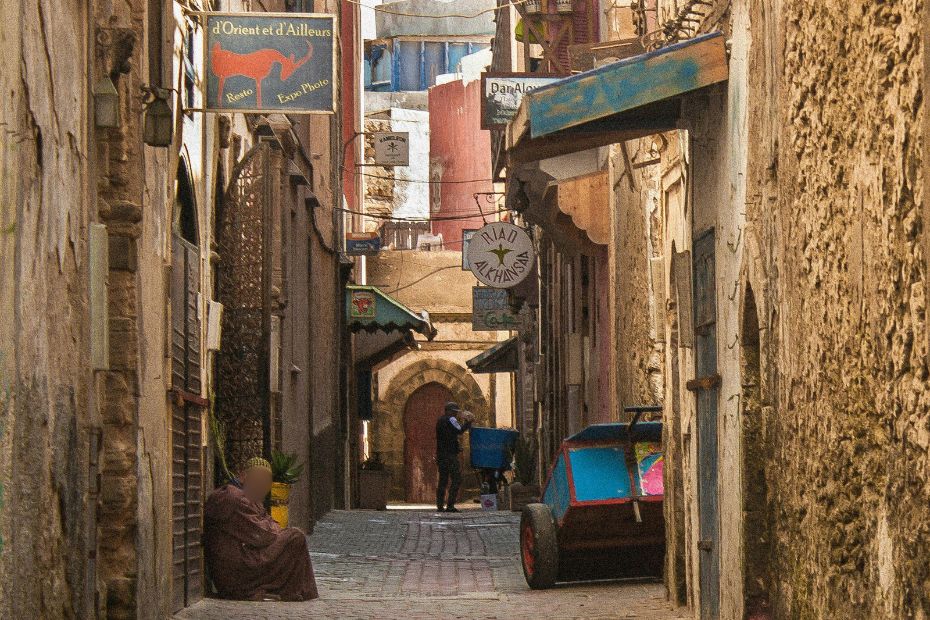
One afternoon in the medina during Ramadan, my friend and I were trying to squeeze our way through the crowds when we noticed a niqabi woman moving from person to person, asking for money.
In Ramadan, they’re everywhere.
If you live in Morocco, then you’ll notice that they tend to be more active in Ramadan, where people are more eager to give charity.
The Tetouan old medina was already hectic at that hour. Everyone was shuffling past each other with urgency and little awareness. Between the fasting, the crowd, and the general medina chaos, I had already reached my limit.
My friend and I had gone to Bab Tout for something, but the moment I saw the woman, I suddenly felt done for the day. I turned to my friend and said, let’s just leave and head to the next place.
As we walked away from the area, the woman started walking in the same direction. At some point, I thought she clocked in on us as her next target, so I fastened my pace.
Then we kept walking, and there she was, still behind us. Thankfully, eventually she drifted off in another direction, but I could still see her from across the street.
Then she stopped, gathered whatever had been sitting in her mouth, lifted her niqab, and spat it onto the side of the road.
Now listen, she didn’t just spit… she spat using her WHOLE body.
I don’t know how to describe it, but I was mortified. I knew there was something about her that I didn’t like!
Sometimes, all it takes is one small act to reveal a great deal about a person…
To make begging a habit, especially in that aggressive, unbothered sort of way, a person often has to silence whatever shame, dignity, or consideration might have held them back.
A fair number of beggars in Morocco are extremely skilled at manipulation.
In many cases, begging operates like a profession, and children are sometimes used to exploit oblivious bystanders. (This is actually an issue here)

30-minute private clarity call
Need straight answers about moving to Morocco?
If you’ve been researching, overthinking, and not knowing what to do, this call gives you space to ask your unfiltered questions.
Bring your biggest concerns, get honest insight, and leave with clearer priorities, realistic next steps, and a calmer head, insha’Allah.
Personal support for readers serious about hijrah, settling in, and making wise next moves.
I’ve had enough unpleasant experiences with beggars in Morocco
…to the point I rather not entertain them anymore (if I could help it)
These days, unless there is something about the situation that genuinely moves me or seems trustworthy, I usually say sorry and keep walking.
You’re probably thinking, Khawla, that sounds a bit heartless.
Look, I am not telling you never to give. Charity is your choice, and may Allah reward every sincere intention. I am simply saying: be careful who you give to, especially on the Moroccan streets.
My main concern is not the legitimacy of their story. As Muslims we still get rewarded nonetheless insha’Allah.
My concern, however, is what usually follows after or, in some rare case, what it involves.
My friend has warned me that some beggars use black magic to entice you to give more. How it’s done, I’m not entirely sure. What I have heard is that money, much like other personal items, can sometimes be used as a link back to the person who gave it.
Another risk, apart from concerns about sihr, is the possibility of ongoing harassment.
This is particularly worth bearing in mind if the beggar is based in an area where you live or somewhere you visit often, such as the school run, the local shops, or other places woven into your daily routine.
We got scammed once by two girls who followed us home from the souq
You can read the entire story here.
One day two girls came knocking on our door, claiming to be sisters and their mother recently had her leg amputated.
They then got our serious attention when they claimed to be Zahra’s neighbours. Zahra was a vendor my mum used to buy vegetables from when we lived in Kenitra.
So naturally, we gave them some money. We know Zahra, and if these girls are buddies with her as they claim, then of course, we extend our care to them as well.
The second time they knocked on our doors, they gave us a bag of tomatoes as a form of gratitude for helping them last time. (Looking back, see how they invested in their scheme?!)
It was all very charming until we realised we had been played, and we confirmed it with Zahra later on. As we came to suspect, she had no idea who the girls were! (Them being neighbours was a lie.)
There are some beggars, like the girls in the story, that once you give them access to your kindness and generosity, they’ll play on it and will see how far they can exhaust it from you.
Another friend of mine once helped a man on the street in her neighbourhood. He had a paper of his story translated into English.
She raised money for him because she believed he was genuinely struggling. Unfortunately, however, after that, it turned into an ongoing harassment.
He approached her again during Ramadan asking for more. He would stop her children in the street and ask where their mother was.
It reached a point where she had to change her route home just to avoid him.
“But Khawla, why are you telling us this?”
I’ve talked to many expats who moved to Morocco, and to them beggars is part of the new scenery.
Many of you, Allahuma baarik, are generous people and wouldn’t give a second thought for giving to those who appears needy. And I really really respect and admire that. May Allah guide us to good character, ameen!
And because I care about you, my dear reader (and fellow migrant), I don’t want you to be a victim of uncomfortable situation. Especially if you could avoid it.
The last thing you want is for a small interaction in the street to grow into something that unsettles your safety or peace of mind. I have spoken about street hypnotic magic in another post as well.
I can’t speak for all beggars in Morocco. Some may genuinely be in need.
That is the difficult part. In many cases, you simply cannot tell.
Unless you intend to start trailing people through alleyways and taking notes, which would be a very odd use of your afternoon.
So where does that leave you, especially if you want to give charity and still protect yourself?
The difficulty is that you cannot easily tell who is truly struggling and who has simply made a habit of begging. Stories do come out of people being exposed as perfectly capable, or far less desperate than they made themselves seem.
For some, begging is no longer a temporary hardship but a long-standing way of life, and they have little interest in pursuing a more dignified means of earning.
I would hate to think that my act of giving was helping to sustain that behaviour. Not to mention, begging is illegal in the country, despite how common it is…
That’s why I would much rather tip a little extra when buying from people selling on the street, or give through someone trustworthy who know a family going through a difficult time.
That’s MY personal preference. Like I said, not saying don’t ever give to beggars on the street, it’s your choice. But I thought I’d give you a heads up of what it might potentially entail.
And may Allah guide us all to do what’s best, ameen.